
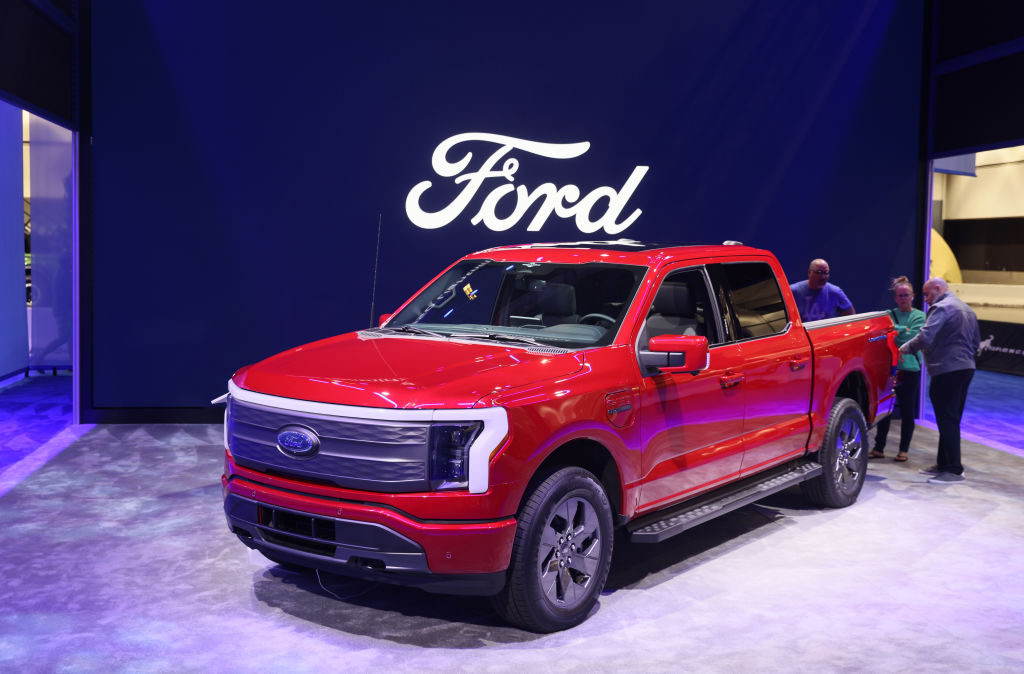
After years of bold EV promises, Ford is retreating from the F-150 Lightning and rewriting its electric future. Josh Lefkowitz/Getty Images
This week, Ford announced it will end production of the F-150 Lightning, the electric version of its best-selling pickup truck, and take a $19.5 billion write-down tied to its current and planned EV programs. The move marks a sharp reversal from commitments Ford made eight years ago to transition toward an all-electric future. Since 2023, the company’s EV business has lost more than $13 billion. The F-150 Lightning was designed to bridge Ford’s core truck buyers to electric vehicles. Instead, a combination of policy headwinds, overestimated demand, rising costs and weak marketing undermined the program.
At its launch in 2022, Ford promoted the Lightning with a video showing a prototype pulling a one-million-pound train. In practice, the truck is rated to tow up to 10,000 pounds when properly equipped, but doing so cuts its range roughly in half, from about 320 miles to 160 miles. The commercial “raised expectations of what they could do, and when people realized how much range is impacted by towing a large trailer, they were really disappointed,” Sam Abuelsamid, an automotive analyst and Vice President of Market Research at Telemetry, told Observer.
Abuelsamid noted that gasoline-powered trucks face similar range penalties while towing. “The Lightning is actually better than the gas version of the F-150 in pretty much every other way.”
Still, sales never matched Ford’s ambitions. The automaker had expected to sell 40,000 to 150,000 units a year, but even at its peak in 2024, it sold just 33,5100 units. By contrast, the gas-powered F-150 continues to sell hundreds of thousands of units annually.
Anticipating high demand initially, Ford relied heavily on components shared with other vehicles in its lineup to scale production quickly, which drove up costs and made the Lightning less efficient to build.
“Instead of ramping up capacity in short order, they should have invested in optimizing systems, which would have also benefited other electric Ford products like the Mach-E and e-Transit,” Abuelsamid said. “With so much underutilized capacity, the fixed costs were way higher than they should have been, which led to a lot of the losses.”
Timing also worked against the Lightning. When the electric truck debuted in 2022, Russia had just invaded Ukraine, disrupting supplies of nickel, a key material in EV batteries. Prices surged, and Ford passed those higher costs on to customers, raising prices and further dampening demand.
Ford pivots to hybrid and A.I. data centers
Ford is now trying to recoup parts of its electrification investment by introducing a hybrid version of F-150 and shift some battery production toward A.I. data centers.
Ford is promoting an extended-range electric vehicle, or EREV, which uses a gasoline engine to generate electricity for the battery. EREVs aim to ease concerns about charging time and range, but Ford hasn’t offered a timeline for an EREV F-150.
The company is also repurposing some of its EV battery plants into battery systems for data centers, a shift other battery makers have already made. LG Energy Solution took a similar approach at its Holland, Mich., plant, which was originally slated to produce nickel manganese cobalt (NMC) cells for electric vehicles. After acquiring GM’s stake in a joint-venture facility in Lansing, Mich., LG retooled the Holland plant to produce lithium iron phosphate (LIP) cells for grid storage and data centers.
“The data center bet, in general, is not a bad idea. Ford has a battery factory, and there is an absolutely huge demand for energy storage systems from data centers,” Abuelsamid said. “The difference…is in timing.”
For Ford, the transition carries risk. “Ford has a plant configured for producing NMC pouch cells that they now have to retool for LFP prismatic cells,” Abuelsamid added. “The revised equipment will probably be coming from China. That means they won’t be producing again until sometime in 2027 at the earliest, paying huge tariffs on the new equipment and risking the data center bubble bursting before then.”
