
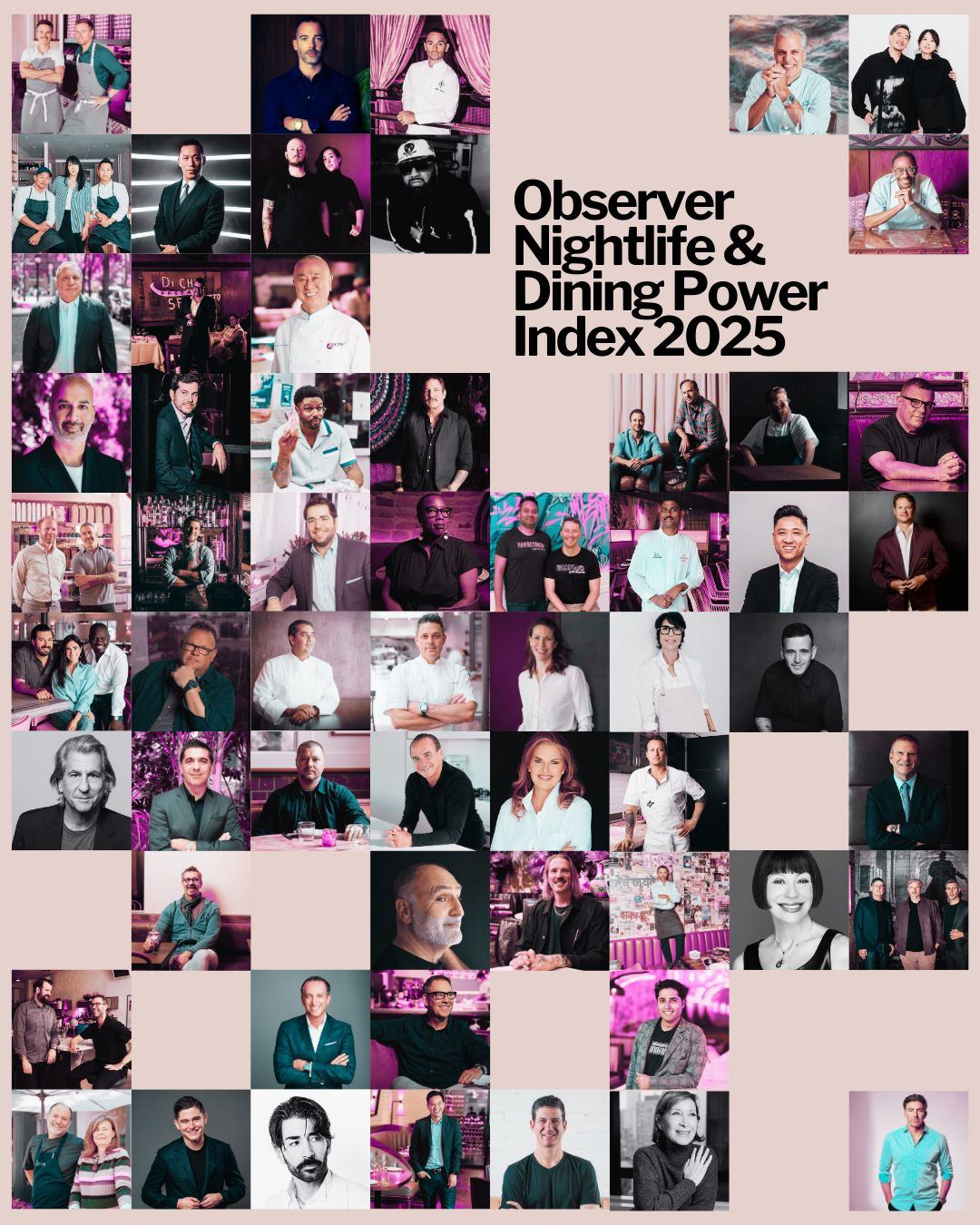
During this moment of A.I. and automation and bots and everything changing all at once, the hospitality business is still about human creativity and having the right people in the right place at the right time. If anything, the people on Observer’s Nightlife & Dining Power List are traveling more than ever as they build empires spanning multiple continents. Consider JP and Ellia Park, who run North America’s highest-ranked restaurant, Atomix. In October, they returned to Seoul (where they lived before moving to New York) as de facto culinary ambassadors for the Hansik Conference. Then they came back to Seoul in November for the opening of their first restaurant in Korea, the eponymous JP at Louis Vuitton.
Mario Carbone had the wildest span of his life this year, as he and his core team embarked on what they called the Rigatoni World Tour, opening restaurants in London, Dubai and Las Vegas in back-to-back-to-back months. Elizabeth Blau, who first made her name in Las Vegas, has her eyes on the Middle East as she continues to work on restaurant development for clients like Wynn. Thanks to the curation of Blau, Wynn Al Marjan Island in the United Arab Emirates will boast a dining and nightlife collection including an Alain Ducasse steakhouse and an outpost of Delilah.
Las Vegas, of course, has long been driven by this kind of curation. The goal is bringing in the strongest global brands, including New York’s Cote (at the Venetian) and London’s Gymkhana (at Aria), to create razzle-dazzle experiences powered by luxury dining with elements of nightlife (like the DJ booth and VIP skyboxes at the Las Vegas Cote).
Las Vegas is also where best-in-class operators that focus on accessible dining can flourish. Scarr’s Pizza, which recently opened at the Venetian’s food hall, is a slice joint. But pizzaiolo Scarr Pimentel used to mill his own flour in his New York basement before he found organic flour up to his standards. Din Tai Fung, a Taiwanese soup-dumpling powerhouse that dates back to 1958, now thrives in California, Las Vegas and New York with its open kitchens where guests can see chefs hand-fold dumplings.
There are clearly trend-setters on this list, but one refreshing thing about the top tier of hospitality is that it’s anti-trend. The future of dining and nightlife isn’t ghost kitchens or superfoods or avatar DJs or Instagram-friendly presentations. What’s moving the industry forward is a desire to create new paths. And hospitality, as always, is about the resilience of human beings.
In Los Angeles, where everything from Hollywood strikes to devastating fires to Ozempic to the rise in minimum wage has hobbled the restaurant industry and led to many closures, adept operators continue to cautiously grow. For prolific restaurateur Jerry Greenberg, this means working to debut two locations of spinoff restaurant Cheesesteaks by Matū in L.A. while also planning the expansion of Uovo to New York. Uovo, not incidentally, has become a sensation by serving pasta that’s hand-crafted in Bologna. The human touch clearly still matters a lot.
Across the industry, leaders are grappling with a persistent labor shortage that is reshaping how restaurants and bars operate. As Cherif Mbodji notes, “The biggest challenge remains labor—finding, developing and retaining great people.” This sentiment is echoed by Jihan Lee, who cites “finding team members who understand the pace and discipline the industry demands” as a major hurdle. “Younger workers enter with different expectations around balance and commitment, which creates tension in a field built on consistency and resilience,” Lee says. The path forward, many suggest, lies in deeper investment in training, mentorship and treating hospitality as a long-term career. Roni Mazumdar frames it as a fundamental shift in mindset: “Hospitality should be treated as a skilled, sustainable profession, not a passion project held together by burnout.” Part of the problem, according to Gavin Kaysen, is that hospitality is a craft that cannot be taught quickly. “It is something you learn over time and with a great amount of practice. We need to meet the generation coming into this profession with empathy, as they are growing up in different times than we did. It does not make our time or their time worse or better, just different.” To do that, JP Park wants the industry to push frameworks that prioritize education, well-being and collaboration among restaurants, producers and cultural institutions. “Many talented individuals are leaving this industry because the system doesn’t support long-term balance or growth,” Park tells Observer. “The future of hospitality will depend on how sincerely we invest in people.”
Hospitality at the highest level, of course, is about creating multiple successful businesses. So whether you’re Strategic Hospitality (the group that has the only three Nashville restaurants with Michelin stars) or MML Hospitality (a dominant force in Austin that recently hired April Bloomfield, expanded Clark’s Oyster Bar all over California and purchased New York’s Nine Orchard hotel) or the New York team behind critical darlings Claud and Penny as well as a forthcoming wine bar, the goal is to always keep things moving at every moment.
In New Orleans, Emeril’s is the only restaurant with two Michelin stars. E.J. Lagasse, the 22-year-old son of the iconic, 66-year-old Emeril Lagasse, is running the kitchen and has turned this restaurant into a next-generation tasting-menu destination. Beyond becoming the youngest chef to helm a two-Michelin-starred restaurant in November (when the first Michelin stars for the American South were awarded), E.J. has had a spectacular year with a glowing New York Times review in October and a spot on the inaugural North America’s 50 Best Restaurants list in September. Sometimes, having the right person in the right place at the right time is as simple as looking within your own family.
Another significant trend is the shift away from alcohol consumption, which is changing beverage programs and business models across the industry. Lisa Limb notes that this has “opened up a whole new avenue for the beverage world” and brought a surge of creativity around spirit-free drinks. But it’s also impacting revenue, as Aaron Bludorn points out: “Seeing our revenues decline for many reasons: lower alcohol sales, people spending less in general and dining out less.” For an industry traditionally reliant on alcohol sales, adapting to this new reality is a challenge. “Rents are going up, the price of goods is going up, salaries are going up,” Eugene Remm says. “You have to do more with less.” Yet, challenges are also opportunities to innovate. “We need systems that support fair wages, reasonable hours and accessible pathways to ownership, while also encouraging innovation in sourcing, waste reduction, and energy use,” Fidel Caballero says.
Beyond these operational pressures, a growing number of consumers are seeking deeper meaning and story behind their dining experiences. Sofia Ostos captures this shift: “People want to understand why something is on the plate, not just how it tastes.” JP Park wasn’t the only honoree to echo this sentiment, nearly verbatim, noting that diners “want to understand the ‘why’ behind what’s on the plate.” In an era of transparency and values-driven consumption, restaurants are being pushed to communicate more sincerely and design experiences that, in Dominique Crenn’s words, “feel personal and emotionally textured.” Or, as Vijaya Kumar puts it: “Real stories, real flavors and places that feel human.”
Humanity is still the most vital ingredient in hospitality, and that isn’t changing anytime soon.