
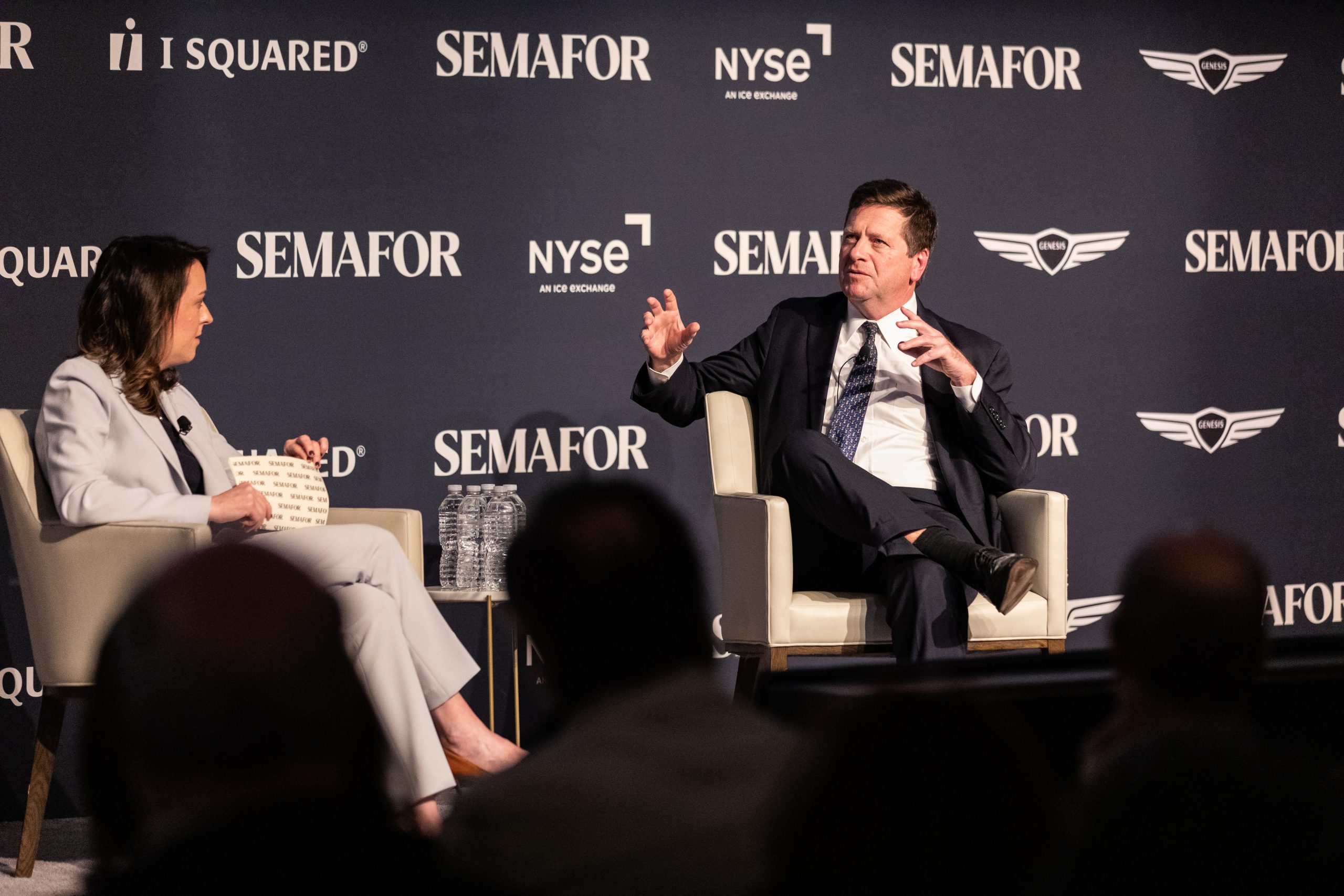
Semafor business and finance editor Liz Hoffman interviews Jay Clayton at the New York Stock Exchange on Dec. 2, 2025. Seamform/Kind Dale
Jay Clayton, the former chair of the SEC from 2017 to 2020, known for his tough stance on cryptocurrencies and protecting retail investors, has a few thoughts on prediction markets—a space that is growing dangerously fast and increasingly blurring the line between investing and gambling.
“In any new thing—and I don’t want to get ahead of the CFTC or the SEC—you have to ask yourself: What function is this product performing?” He said yesterday (Dec. 2) during an interview at a semafor event hosted at the New York Stock Exchange.
One such “new thing” Clayton dealt with during his SEC tenure was initial coin offerings, or ICOs. His view was that ICOs serve the same purpose as IPOs and therefore are subject to U.S. securities laws.
“People were like, Oh no, it’s not a stock, it’s a coin. Well, it’s an investment in a company that you expect to get a return, so the function it’s performing is the same as a stock or the same as some kind of bond,” Clayton said.
He then returned to prediction markets. “The real question is what function are prediction markets providing?” He said. “When does it look just like a cash-settled option on a stock? And when does it look like a bet on a football game? Those are two different functions… If I go into the betting shop and buy a cash-settled option on American Express, should it just be regulated as a bet or should it be regulated as a cash-settled option?”
There’s no easy answer. In the U.S., prediction-market contracts are treated as derivatives or event contracts, putting them under the authority of the Commodity Futures Trading Commission (CFTC). Both Polymarket and Kalshi operate under special CFTC licenses as regulated exchanges under U.S. derivatives law. However, some types of event contracts—particularly those tied to sports or gaming outcomes—may face additional restrictions under state-level gambling laws.
Both companies have had bumpy paths in reaching U.S. customers. Polymarket was banned by the CFTC in 2022 for offering unregistered event contracts. Some U.S. users stayed on the platform by using VPNs. It officially returned to the U.S. last month after receiving an amended Designated Contract Markets license from the CFTC. Kalshi has faced similar scrutiny, including a Nevada court ruling last month that some of its sports contracts fall under state gaming law rather than federal oversight.
“People look for regulatory relief by providing a close enough function to something that’s highly regulated, and then they can operate under less regulation…But you have to ask yourself, is it far enough away from a current function that’s finally regulated that it should be regulated differently?” Clayton said. “Luckily, I don’t have to think about those things.”
Clayton is now the U.S. attorney for the Southern District of New York, a role President Trump appointed him to in April.
Prediction markets are breaking into the mainstream. The young founders of both Polymarket and Kalshi recently became billionaires as their companies’ valuations soared.
Last month, the NYSE’s parent company, Intercontinental Exchange Inc. (ICE), announced plans to invest $2 billion in Polymarket and distribute its data to institutions worldwide. Polymarket is reportedly nearing a valuation between $12 billion and $15 billion as it pursues a new funding round.
