
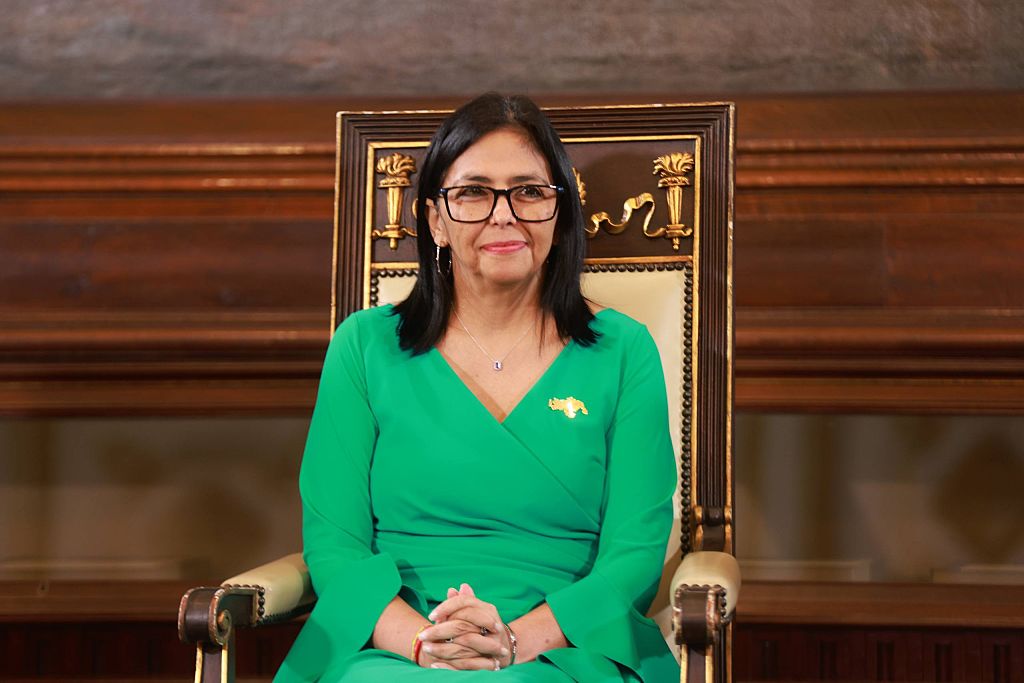
Delcy Rodríguez, long a key Maduro ally and former vice president of Venezuela, became the country’s acting president on Jan. 5, 2026. Venezuelan National Assembly/Anadolu via Getty Images
Amid renewed political turmoil in Venezuela and intensified U.S. pressure on the country’s leadership, attention has largely focused on what comes next for the nation’s devastated oil sectorand whether U.S. companies might play a role in rebuilding it. President Donald Trump has suggested that American oil firms invest at least $100 billion in Venezuela, a figure that drew a lukewarm response from industry executives wary of political risk and decaying infrastructure.
Beyond oil, however, some business leaders and entrepreneurs are beginning to discuss what investment in Venezuela could look like if the country’s political and economic conditions stabilize. After more than a decade largely cut off from Western markets by sanctions and capital controls, Venezuela faces steep hurdles to becoming business-friendly again. Still, some see the possibility, however distant, of a broader rebound. With sweeping reforms, they argue, what remains of the country’s battered startup ecosystem could reemerge.
Foreign investment in Venezuela is currently negligible compared with regional peers, Francisco Litvay, an entrepreneur whose firm, Sudamerica Hub, helps companies establish offshore operations or relocate within South America, told Observer. The upside, however, could be enormous. The “upside if the country stabilizes and is able to attract its diaspora back is gigantic,” he said.
Roughly 8 million Venezuelans have fled the country in recent years, most settling in nearby nations such as Colombia. A meaningful return, Litvay said, could reignite domestic consumption and help revive sectors beyond oil, including agribusiness, real estate and technology. He pointed to companies such as Venezuelan superapp Yummy and fintech Cashea, along with the Venezuelan Association of Private Capital, as forces keeping the startup ecosystem alive despite severe constraints.
If conditions improve, Litvay also believes Venezuela’s capital city, Caracas, could eventually join cities like Medellín and Mexico City as a regional startup hub. “Caracas has many of the characteristics that made Medellin the largest (digital) nomad hub in South America: Mild climate year-round, geographic proximity to North America, fun culture, great lifestyle — with the difference that Caracas is right by the Caribbean,” he said.
Political stabilization could also give rise to what some describe as a “reconstruction market,” according to Stephany Oliveros, a Venezuelan entrepreneur. While Venezuela’s oil infrastructure will take years and vast sums to restore, she said, other sectors could gain traction sooner. Fintech, logistics, workforce upskilling, energy reliability, health care access and consumer-facing apps are among the areas she sees as early opportunities.
Oliveros, who fled Venezuela in 2017 and now lives in Spain, is a university lecturer and the founder of SheAI, a platform that provides A.I. education for women. Companies that can reliably serve a returning professional diaspora, she said, will “win early.” The startup ecosystem itself may even benefit from years of scarcity, as “founders build lean, scrappy systems fast.”
She recalled her time studying medicine at the University of Central Venezuela, when she improvised IV stands out of broomsticks and shoelaces. “Improvisation and adaptability is 100 percent the number one trait that defines a Venezuelan,” she said. According to Global Entrepreneurship Monitor, 22.7 percent of Venezuelan adults were starting new businesses in 2023, despite the difficulty of sustaining them.
Still, the obstacles to making Venezuela attractive to investors remain formidable. Chief among them is whether any political transition would dismantle entrenched corruption and establish credible economic reforms. “The main risk in my opinion is that the transition is done without the necessary removal of corrupt institutions and reforms to reopen and liberalize the economy,” Litvay said. “From property rights to business regulations, taxation and immigration laws, Venezuela currently is one of the most complex and unfriendly countries to do business.”
The last available World Bank Ease of Doing Business ranking, published in 2020 before the index was discontinued, placed Venezuela 188th out of 190 countries. Oliveros added that unreliable infrastructure, shallow local capital markets and the persistent threat of abrupt policy shifts further complicate the outlook. “Even with political improvement, investors and startups dealing with cross-border payments, oil-linked revenue, or U.S. touchpoints face heavy compliance overhead and sudden policy shifts,” she said.
Despite it all, Oliveros said she remains cautiously hopeful about Venezuela’s future. “I want Venezuela to have a ‘South Korea’ moment, but it seems unlikely if we look at history,” she said.
