
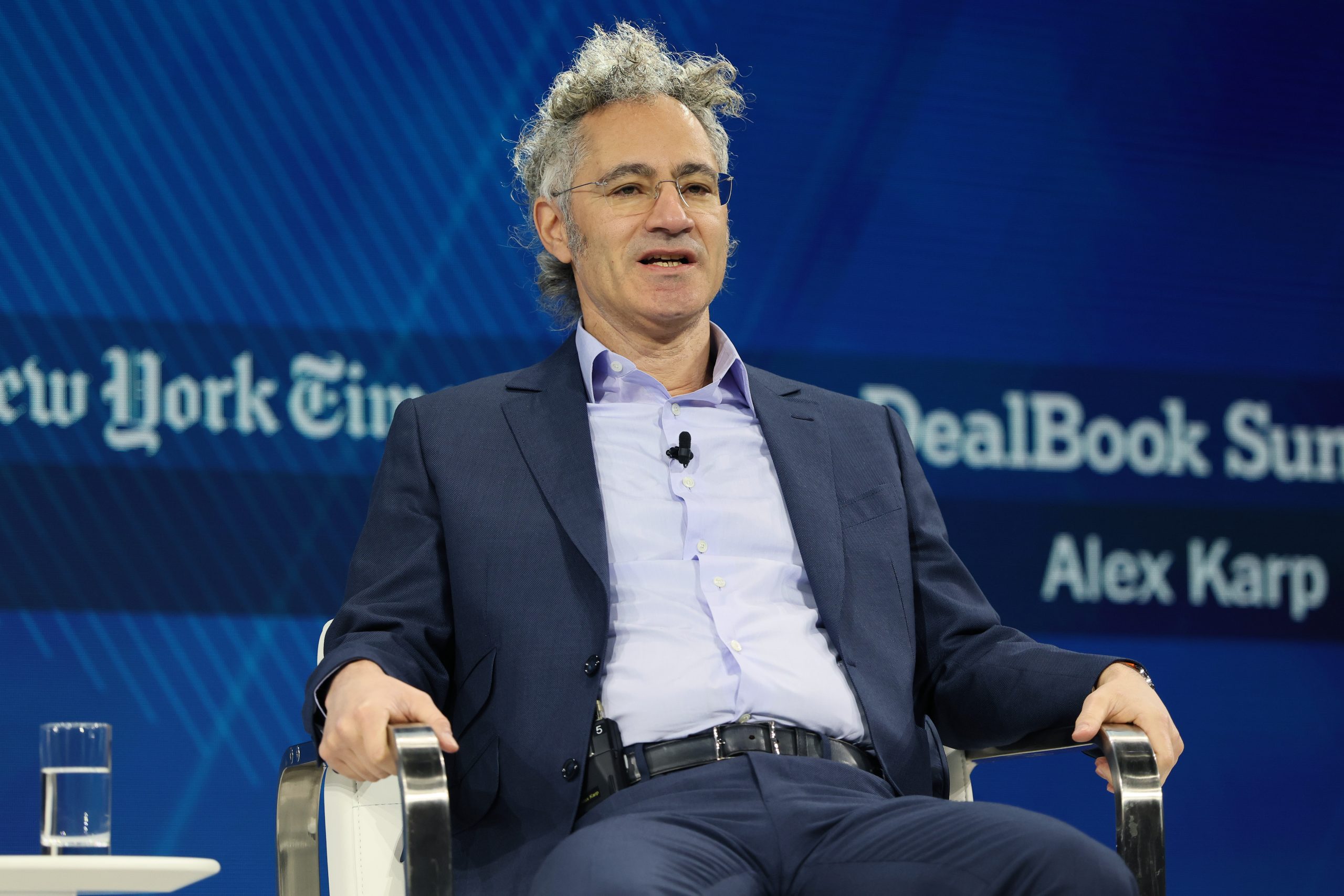
Alex Karp, CEO of Palantir, speaks onstage during the 2025 New York Times Dealbook Summit on Dec. 3, 2025 in New York City. Photo by Michael M. Santiago/Getty Images
Alex Karp, CEO of Palantir, is standing by his firm’s work with U.S. government agencies, its stance on surveillance and its ambitious outlook. The software company’s confidence has so far been backed up by rapid growth, noted the outspoken executive during the New York Times’ Dealbook Summit today (Dec. 3).
“The critique I get on Wall Street is that I’m an arrogant prick. Okay, great,” Karp said during a heated onstage interview with the DealBook founder Andrew Ross Sorkin. “If you’re right a lot, maybe exerting that you’re going to be right tomorrow is pretty important.”
There’s no question that Palantir, which specializes in data analytics, has surged amid the A.I. boom. Its stock price has skyrocketed more than tenfold in the past two years. The company reported a 63 percent year-over-year increase in revenue in its most recent quarter. It has benefited from a wave of government deals, securing more than $126 million in federal contracts in September alone, according to USAspending.gov.
Palantir’s flurry of federal deals under the current administration has coincided with scrutiny over whether it is enabling government surveillance. Karp pushed back against such claims bluntly: “Are we building a database that can be used for surveillance? No.”
He noted that Palantir has historically been selective about the clients it takes on. The company has turned down business from cigarette manufacturers and ended contracts with U.S. institutions engaging in racial profiling, Karp said, adding that Palantir also refuses to work with China or Russia.
“We did this at points where it was critical, and we were in desperate times financially,” said the CEO. “We did this at times when it could have absolutely crushed our company.”
Palantir was founded in 2003 by Karp and Peter Thiel, a major donor to the Republican Party. Karp has long identified as a Democrat, in contrast to Thiel’s more conservative politics. Sorkin noted how the two founders’ differing political leanings may have helped Palantir win business from both sides of the aisle early on. Today, both Karp and Thiel seem firmly on the right and embracing President Trump’s policies.
Palantir’s most controversial work recently is helping the U.S. Immigration and Customs Enforcement (ICE) to identify immigrants and aid in the administration’s deportation campaign. Karp defended his company’s work, noting that he supports Trump’s performance on immigration and encouraging Americans to “stay skeptical” on the topic. Politically, he stressed that he is an “independent” whose vote “remains up for grabs.”
Palantir is among the world’s most valuable companies, with a market cap of $416 billion. Its meteoric rise has become entangled in concerns about an A.I. bubble marked by unsustainably high valuations. Karp dismisses bubble worries and maintains that Palantir’s high value is backed by business fundamentals, especially in the U.S., which accounts for roughly three-quarters of its revenue.
