
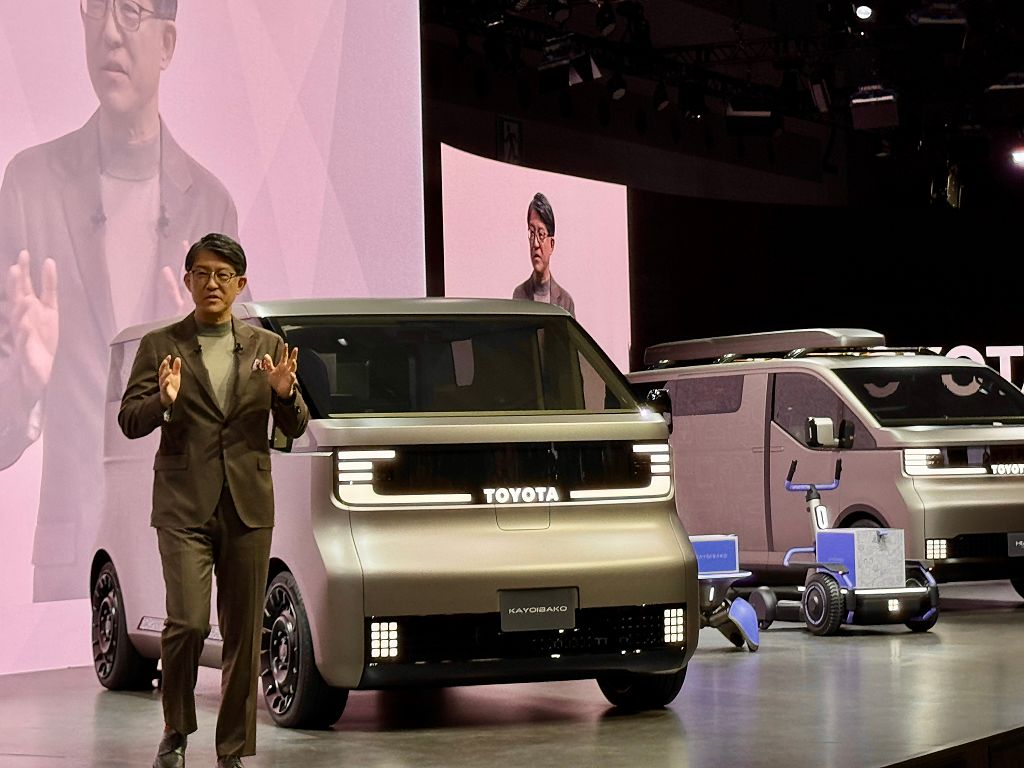
Koji Sato, CEO of Toyota Group, speaks at a press briefing during the Japan Mobility Show 2025 on Oct. 29, 2025 in Tokyo, Japan. Zhang Xiaoming/VCG via Getty Images
Toyota has long been criticized for its cautious embrace of electric vehicles. But amid slowing demand, tariffs and the phase-out of tax incentives, the world’s largest automaker’s deliberate approach looks increasingly like a smart hedge.
The Japanese automaker reported yesterday (Nov. 5) that it sold 4.78 million vehicles globally between April and September, up 12 percent from the same period last year. That included 2.27 million hybrid electric vehicles, a record high. Still, U.S. tariffs took a toll: operating income fell by $3.3 billion from a year ago to $12.5 billion for the fiscal half-year.
Despite those geopolitical headwinds, demand for Toyota’s reliable passenger cars remains robust. CFO Kenta Kon told investors the company is struggling to keep up with demand, saying it can “barely cover the demand.” According to Kelley Blue Book, dealers typically aim to hold about 60 days of inventory on their lots. Toyota’s U.S. inventory, by contrast, is hovering around 30 days.
Toyota has long been hesitant to fully commit to battery-electric vehicles, but the company is a leader in the hybrid vehicle space, touting its more conservative, balanced approach to electrification as the right path forward. Battery-electric vehicles are only a sliver of Toyota’s global mix (just 1.4 percent of total sales in 2024). The long-term risk, of course, is that markets like Europe and China, which are racing toward a fully electric future, could leave Toyota lagging behind.
The company’s best-selling model, the RAV4, will be offered only as a hybrid or plug-in hybrid beginning in 2026. Retooling factories for the new powertrains will require temporary shutdowns, potentially tightening supply even further. A slimmer dealer inventory could also push up vehicle prices for U.S. consumers in early 2026.
Toyota’s small steps toward software-driven cars
The next-generation RAV4 also marks another turning point: it will be Toyota’s first software-defined vehicle (SDV). While startups like Tesla and Rivian built their cars around software from the start, Toyota’s move represents a major step into that domain. The new RAV4 will feature Arene, a Woven by Toyota software platform enabling over-the-air (OTA) updates—an early signal of Toyota’s digital ambitions and a reminder of how far it still has to go.
In typical Toyota fashion, the rollout is cautious. The 2026 RAV4 will debut features that rivals have offered for years, such as a smartphone-like cockpit interface, conversational voice commands and OTA updates. But those updates will be limited to ADAS systems and cockpit displays, not the deeper vehicle functions that Tesla, Lucid and others regularly tweak via software. The strategy underscores Toyota’s effort to catch up with competitors, especially those in China, which have already made software a core part of their vehicles.
Toyota now finds itself straddling two eras of the auto industry: one built on mechanical excellence and another driven by software, connectivity and climate regulations. Its hybrid-first strategy has cushioned profits as global EV momentum slows and tariffs rise. But the clock is ticking. If Toyota can extend its hybrid playbook into the software-defined, electrified era it’s hinting at with the new RAV4, it may retain its crown. If not, the conservative approach that once protected it could soon become its greatest liability.
